
Ever wonder why your new systems fall apart after the consultant leaves?
You hired a tech or operations person to fix a specific problem in your business. They came in, built something that finally worked, and left. A few months later, everything fell apart.
If that sounds familiar, you're not alone, and it probably wasn't the builder's fault. In my experience, it comes down to three things: your expectations, your mindset, and the skills of the team left running the system.
I'm Kronda Adair, CEO of Karvel Digital. I'm a systems strategist and process mapping expert, and my job is to make your invisible processes visible. Here's what I see go wrong, and what to do about it.
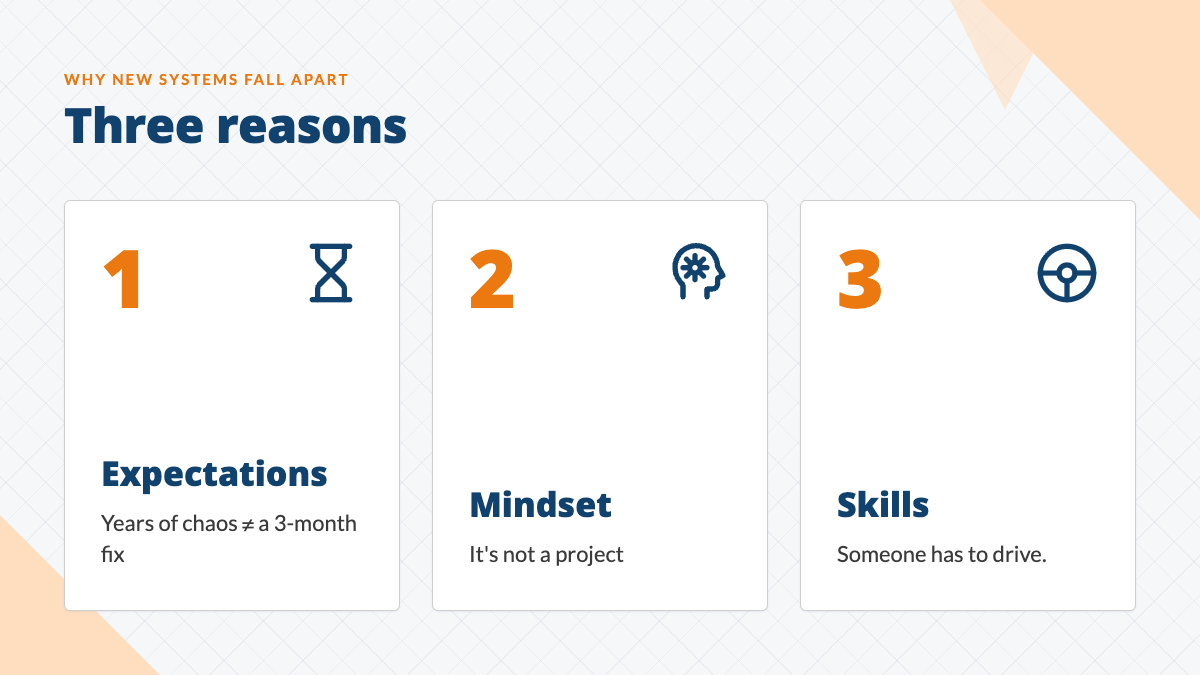
Reason 1: Your expectations
Years of managed chaos don't turn into streamlined systems in a few months.
Most people wait until they're in real pain to work on their tech and operations. By then, they've spent years running the business on memory, Slack threads, email chains, and pure scrappiness. That gets you surprisingly far. Then it stops working.
By the time a team calls someone like me, there's years of mess to clean up, and they want the pain gone fast. That makes sense. But depending on how long it's been, how big the mess is, and how big your team is, getting out of it might take more than a few months. It might take more than a year.
It took a while to make this mess. It's going to take a while to get out of it, and it's going to take a real investment of time and money. Go in expecting that, and you'll make better decisions along the way.
Reason 2: Your mindset
Automation and AI aren't a project you finish. They're a fundamental change in how your business runs.
A lot of teams come into these engagements thinking, "Kronda's going to come in, do the project, and then it's done." That mindset is the one most likely to get you in trouble.
When you bring in automation or AI, you're changing how people and software work together, every day. That requires change from you and from your team. It shows up in who owns which step, how work gets handed off, and what happens when something breaks. Be mentally prepared for that before the build starts, not after.
Reason 3: Your team's skills (builders vs. drivers)
This is the big one, and I explain it with cars. Someone has to build the car, and someone has to drive it.
Someone like me is a builder. I can look at your operations, your systems, and your technology, and build you a new and improved system that runs a whole lot smoother than what you have now.
Once that system is built, you need people on your team who can drive it. That doesn't mean they need to go into the back end and fix things. It means that day to day, they can use the tools that were built and get their work done with a minimum of friction.
Here's where it goes wrong. If your team has little to no technical experience, and someone builds you a very technical system with databases, automation, or AI, nobody knows how to drive it. The system doesn't break. It just sits in the driveway.
When you buy a car, you know you're going to need insurance. When you get a whole new system built on modern technology, you're going to need someone with experience in that technology to drive it for you. That's how you actually get the benefits you paid for.
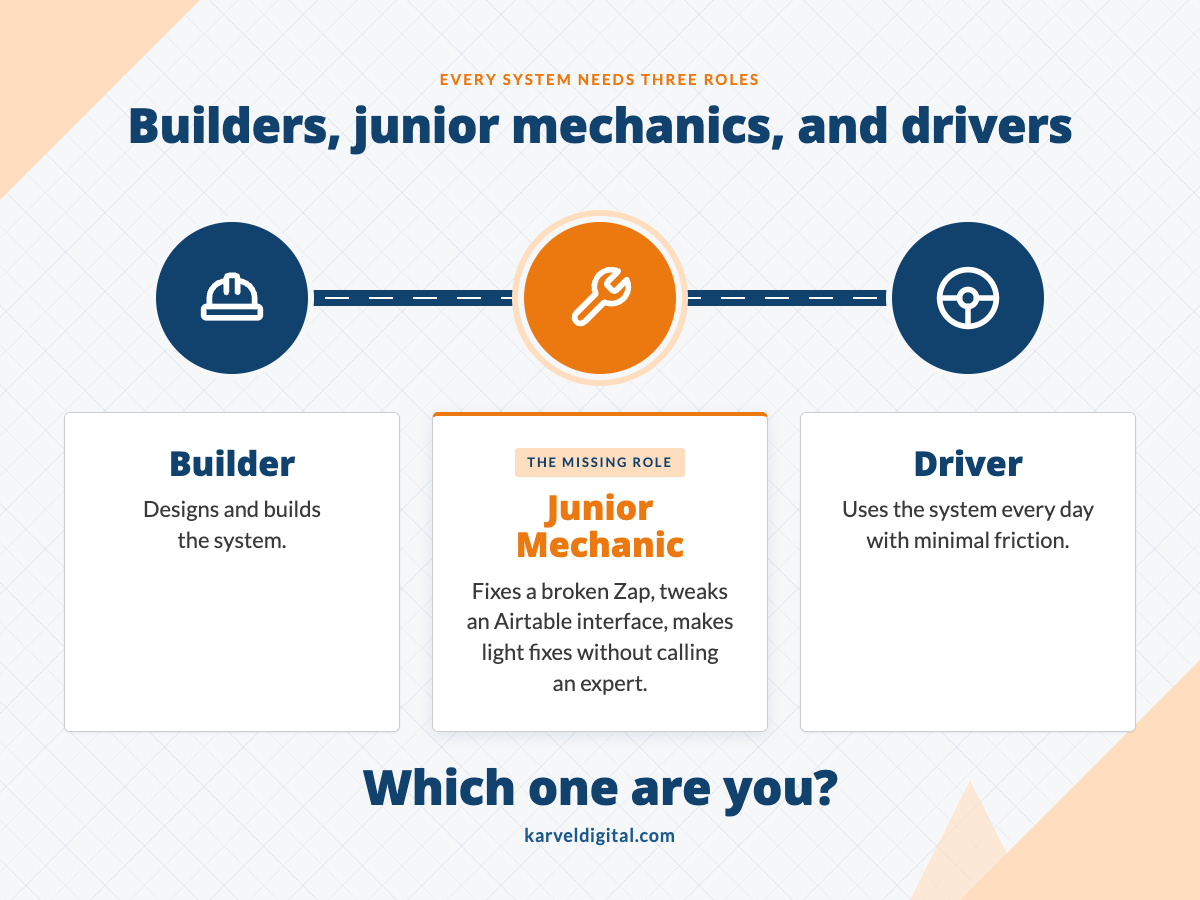
The role in between: the junior mechanic
Between your builders and your drivers sits the role most teams are missing: the junior mechanic.
A junior mechanic is comfortable going under the hood. If a Zap breaks, or something changes, or you want to adjust an interface in Airtable, they can change the oil and make light fixes without calling in an expert.
Without someone in that seat, every small hiccup turns into a support ticket, an invoice, or a workaround nobody writes down. With one, your system keeps up with your business instead of falling behind it.
If you want to go deeper on this, listen to my full podcast episode, Automation Is Not Autopilot: What It Really Takes to Maintain Your Systems.
The bottom line
Hiring someone to come in and rebuild systems is only half the job. The other half is what your team does to manage the new system, and which behaviors you change so you actually get the benefits of what you invested in.
So which are you: a builder, a junior mechanic, or a driver? And if you don't even have your learner's permit yet, that's okay too. Here's where to start:
- Need a builder? Book a Systems Blueprint Call and let's map what you have before anything gets rebuilt.
- Want your team driving with confidence, or ready to become the junior mechanic? That's what Automation Club is for.
Keep going:
