Begin as you mean to go on
You Can't Delegate Chaos: Building Sustainable Operations for Mission-Driven Teams



A Conversation About Achieving Sustainable Operations with Noelia Sanchez of Ops and Outcomes
I've been saying it for years: you can't delegate chaos. And yet, I keep meeting overwhelmed leaders who think the solution to their operational breakdown is just hiring more people.
If you've ever felt like your nonprofit is one resignation away from a crisis, this conversation is for you.
I recently sat down with my good friend Noelia Sanchez—producer, systems thinker, and host of the Ops and Outcomes podcast—to talk about what it actually takes to build sustainable operations in mission-driven organizations. Noelia has been serving nonprofits for years, and as someone who's relatively new to the nonprofit space, I wanted to learn from her experience while sharing what I've discovered about strategic automation and process mapping.
The Foundation Problem
Here's what we don't talk about enough: most organizations are trying to automate before they have the foundations in place.
They want the relief that automation promises—and they should have that relief—but they're skipping the crucial first step of actually understanding what's happening in their business right now.
As I told Noelia, I'm basically the architect now. Before we talk about automation, before we talk about AI, before we even talk about which tools to use, we need to map out what you're actually trying to build.
The C.L.E.A.R. Framework
During our conversation, I walked through my C.L.E.A.R. framework—the system I use to help organizations move from operational chaos to strategic clarity:
- Clarify processes: Get what's in people's heads onto paper (or better yet, into a visual map) so everyone can actually see how work gets done.
- Liberate time: Identify the manual, repetitive tasks that are eating up your team's capacity—especially the "it only takes five minutes" tasks that add up to hours every week.
- Elevate data: Audit what you're collecting, clean it up, and consolidate it into a single source of truth so you can actually make decisions based on real information instead of guesswork.
- Automate: Once your processes are clear and your data is clean, then you can automate the data flow and eliminate those time-consuming manual steps.
- Repeat: This isn't a one-time project. It's a culture shift. You're fundamentally changing the way your organization works so that people and software can collaborate effectively.
Decision-Grade Documentation
One phrase that came up in our conversation—and one that Brian (CEO of Puzzle) and I are trying to make stick—is decision-grade documentation.
Most organizations have documentation scattered across Google Docs, someone's brain, and maybe a few outdated SOPs that nobody follows. That's not documentation—that's institutional chaos waiting to walk out the door with the next resignation.
Decision-grade documentation means having a centralized, visual, up-to-date map of your processes that shows:
- What actually happens at each step
- Which tools are being used (and how often)
- Which roles are involved
- What data is being collected
- Where the gaps and bottlenecks are
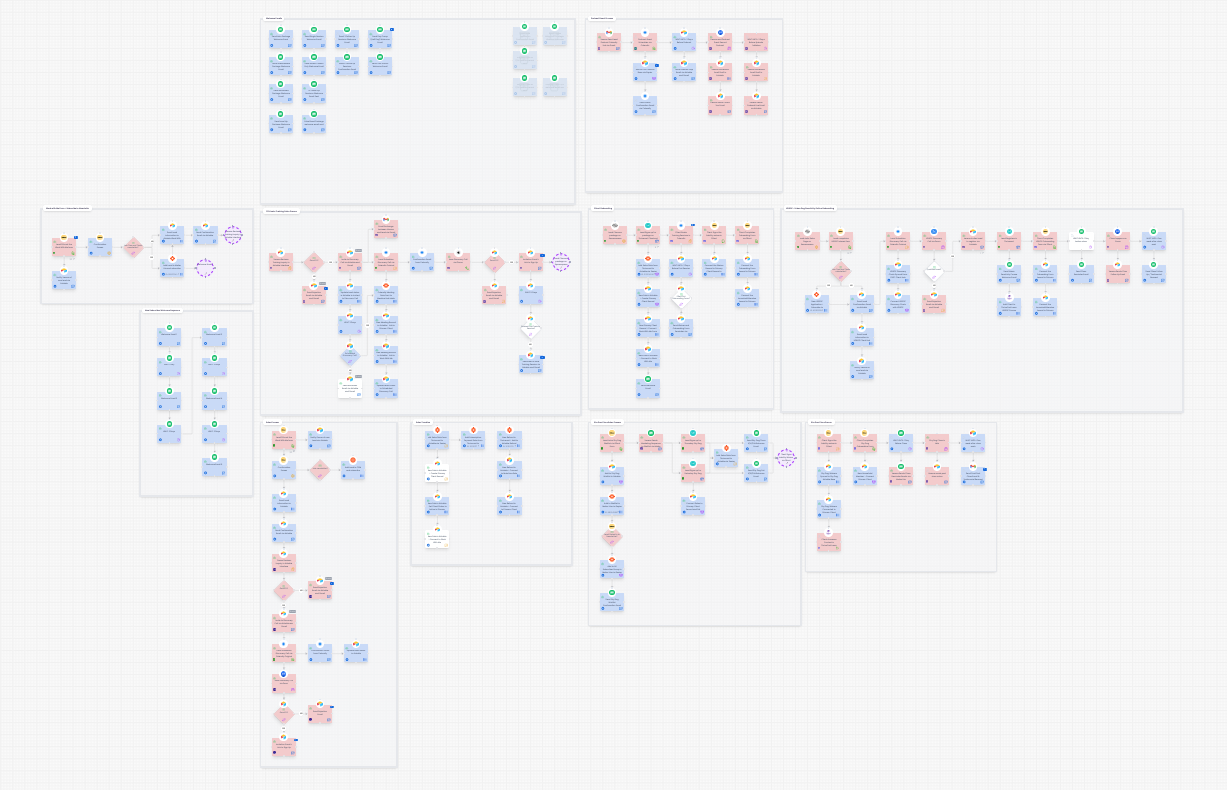
When you have that level of clarity, you can make informed strategic decisions about where to invest, what to improve, and what to automate.
Why This Matters for Nonprofits
Noelia pointed out something crucial: funding is changing in the nonprofit space. With federal funding cuts, foundations and individual donors are picking up the slack—and they're making decisions based on data.
If you can't demonstrate your impact with clean, reliable data, you're going to struggle. And if your systems are chaotic, your data is going to reflect that chaos.
Storytelling is still powerful. Anecdotes still matter. But the data piece can't lag behind anymore.
The Culture Shift Nobody Talks About
Here's what people don't understand about automation and systems work: you're not just implementing a project. You're changing your organizational identity.
You're shifting from being an organization that relies on heroics and institutional memory to being an organization that documents its systems and makes that documentation a habit.
That's a long-term commitment. And it requires leadership to prioritize it, even when it feels slower than just "throwing bodies at the problem."
How to Start Improving Your Systems
If you're reading this and thinking, "Okay, but where do I even begin?"—start with one core process.
Pick the process that's causing the most pain right now. Maybe it's your onboarding workflow. Maybe it's how you track program outcomes. Maybe it's how client information moves from intake to service delivery.
Map it out. Get it visible. See what's actually happening versus what you think is happening.
You'll be shocked at what you find—and you'll finally have the clarity you need to make real improvements.
The Bottom Line
Nonprofit work doesn't have to lead to burnout. Mission-driven work can be sustainable. You can do the work you care about in a way that honors your life and your team's capacity.
But you can't skip the foundation.
You can't automate your way out of chaos. You can't hire your way out of undocumented processes. And you can't make good decisions without clean, accessible data.
Start with clarity. Everything else builds from there.
Want to hear the full conversation? Listen to this episode on the Begin As You Mean to Go On podcast or on Ops and Outcomes with Noelia Sanchez.
Ready to map your first process? Check out the Puzzle Jump Start for the fast track to mapping your first process.
Connect with me:
- Website: karveldigital.com
- LinkedIn: Kronda Adair
Connect with Noelia:
- Podcast: Ops and Outcomes
- LinkedIn: Noelia Sanchez
YOUR HOST
Kronda Adair
Let's Work Together
If your tools are duct-taped together and your workflows are a mess of “ask Jasmine where that is,” it’s time to map what’s really going on.
 Join me for an upcoming Process Mapping Workshop to start visualizing your backend like a real CEO—not a firefighter.
Stay Connected:
- Follow me on Instagram | @KarvelDigital
- Follow me on LinkedIn | @KrondaAdair